ActiveRocketsEmbeddedAerospace
Rocket TVC
Thrust vector control architecture for small rocket experiments
RoleMechanical and Embedded Integrator
Timeline2026–Present
ControllerESP32
MechanismCompliant gimbal
ValidationHardware-in-loop bench test
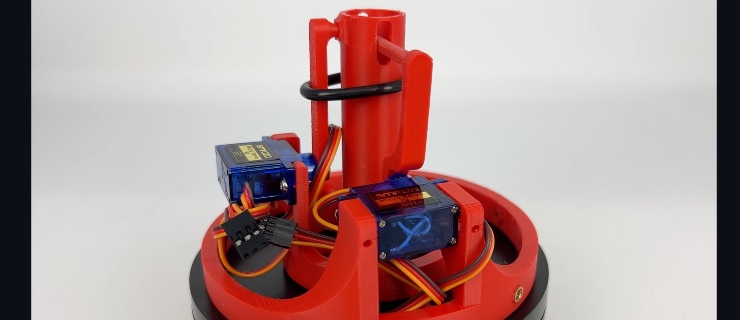
Overview
A thrust vector control prototype for small-scale rocket stabilization experiments. The work centers on a TVC stack that can be tested through hardware-in-loop bench experiments before any propulsion integration.
The problem
Build a TVC mechanism that's responsive enough to be useful and mechanically reliable enough to trust in a test stand context.
Constraints
- Actuator latency must be low enough for meaningful control loop bandwidth
- Mechanical backlash directly corrupts closed-loop stability and has to be designed out
- Power-to-weight tradeoff between motor size and system mass
Design decisions
- Compliant mechanism for gimbal motion. Eliminates the backlash you get from traditional bearing-and-linkage setups.
- ESP32 as controller with dedicated PWM output for servo actuation
- Test harness first: validate the control loop on the bench before any propulsion integration
Build process
- 01
Controller framework and signal routing validated on bench fixture
- 02
Mechanical gimbal prototyped in PLA, backlash characterized before control tuning
- 03
Linkage geometry reworked after initial backlash measurements exceeded predictions
Result
Core control architecture functional. Actuator selection and loop tuning in progress.
What went wrong / what I learned
- Backlash sensitivity was significantly higher than predicted. I should have treated linkage stiffness as a primary design parameter from the first iteration.