Doorboard
A local-first smart door and smart room system
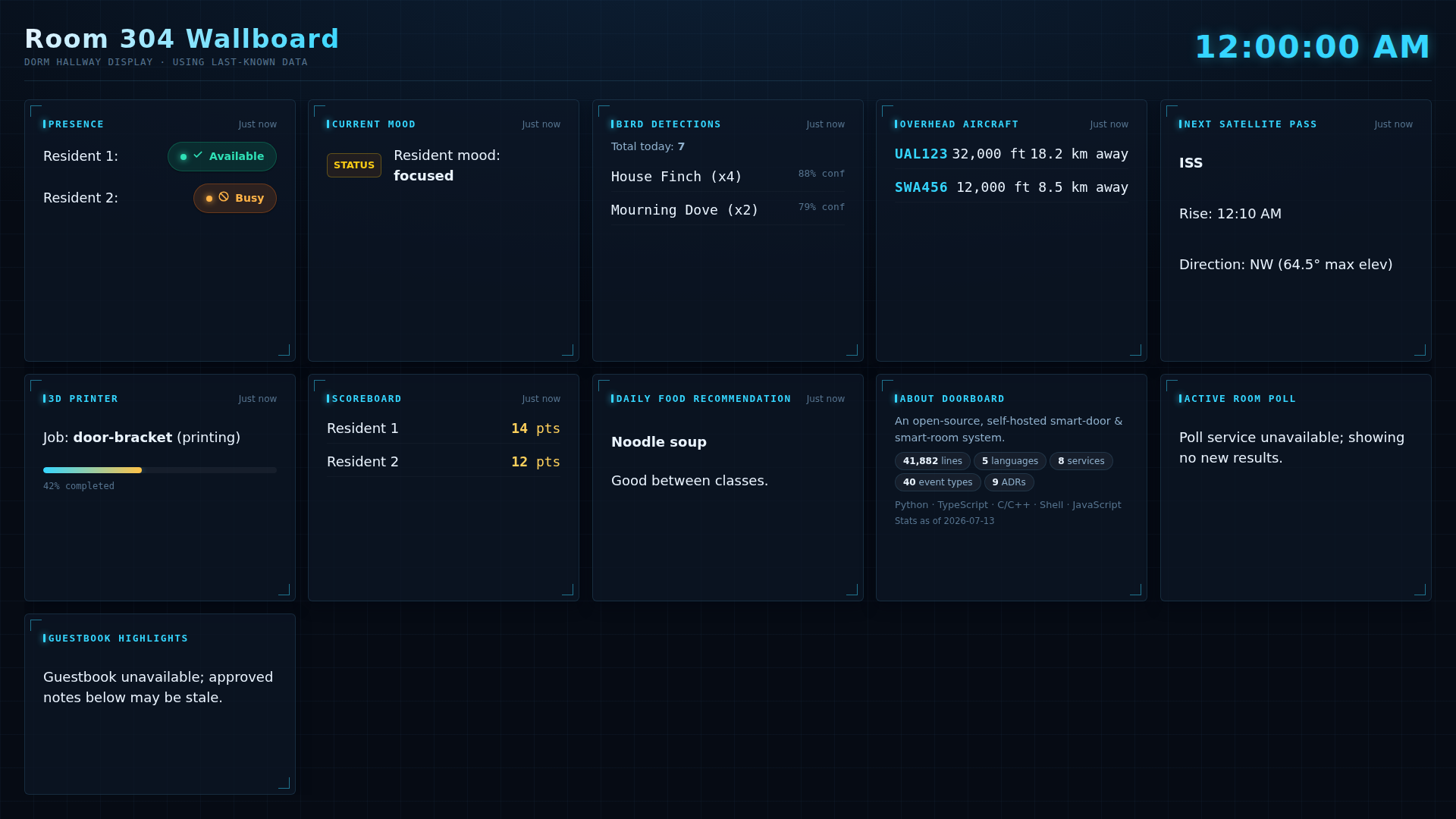

An open-source, self-hosted smart-door and smart-room system built around a removable door-mounted appliance. A Raspberry Pi 5 with a Hailo AI accelerator runs the door-side camera and visitor experience, an ESP32 handles immediate physical I/O, and an indoor NUC provides the wider control plane. The system also ties together an ambient wallboard, visitor sessions, local face recognition, birds, aircraft, satellites, 3D-printer status, food recommendations, a photo booth, and a NAS archive.
Make a feature-rich smart door react immediately even when the NUC, NAS, cloud services, Home Assistant, background jobs, or a fresh AI inference are unavailable.
- Physical door interactions must never depend on the network or control plane
- Face recognition and visitor media need a privacy-aware, local-first data model
- Services span an ESP32, door Pi, NUC, BirdNET Pi, ADS-B Pi, and NAS
- Hardware bring-up must preserve the behavior already accepted in simulation
- Split the system into a real-time door plane and a wider control plane
- Give the ESP32 ownership of physical feedback while the Pi 5 + Hailo own local vision and media
- Use typed event contracts and offline-tolerant queues between services
- Keep the project self-hosted and open source under the MIT license
- 01
Defined the system architecture, trust boundaries, latency budgets, event catalog, and wire protocols
- 02
Implemented and verified the eight software milestones from real-time I/O through security and performance hardening
- 03
Built simulator, integration, end-to-end, and performance suites so the distributed system can be accepted without the final hardware online
- 04
Prepared hardware bring-up, deployment, monitoring, backup, and recovery runbooks
All eight software milestones are accepted in the hardware-free simulator. Physical bring-up and on-device acceptance for the Hailo, ESP32, cameras, and live external services are next.
- The cleanest way to guarantee immediate physical feedback is to make the fast path independent by architecture, not by hoping every dependency stays online.
- Simulation is most useful when it exercises the same contracts, state machines, and failure modes as the eventual hardware.
Tools & Methods
Specs
- Edge computer
- Raspberry Pi 5 + Hailo
- Real-time I/O
- ESP32-S3
- Status
- Software accepted in simulation
- License
- MIT